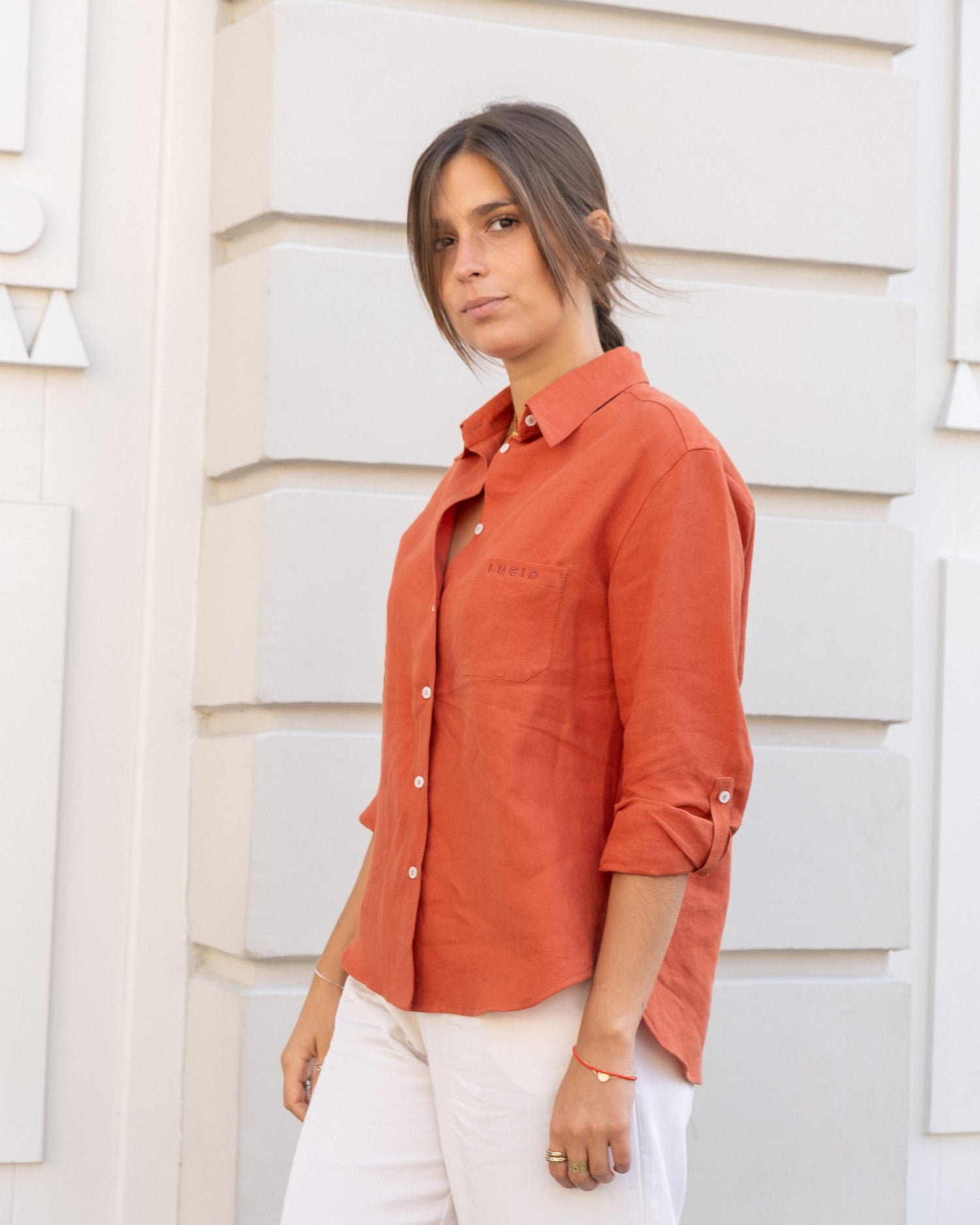

If there's one item you absolutely need in your wardrobe, it's the linen shirt. A timeless classic, it adapts to all situations: worn casually by the pool, at a summer cocktail party, or integrated into a more dressed-up outfit, it easily accompanies daily life. Lightweight, comfortable to wear, and naturally elegant, the linen shirt offers comfort and ease that are hard to beat.
It's no accident that it has become an essential. Linen is a natural fiber with unique properties: breathable, thermo-regulating, and durable, it is particularly suitable for clothes designed to last. Mainly grown in Europe, without artificial irrigation and with few inputs, linen also contributes to a more environmentally friendly approach. These are all reasons why this material is so appealing and why some linen shirts make all the difference.
In a market with increasing options, some brands stand out for the quality of their items, their refined styles, and their commitment to more sustainable and ethical fashion, through their choice of materials and production chain.
This article aims to help you choose a high-quality, well-cut linen shirt made with a responsible approach, so you don't have to look elsewhere.
Lucid Collective
Lucid offers uncompromising linen shirts for women and men. The linen used is organic European linen, grown in France, woven in Belgium, and Masters of Linen certified, guaranteeing complete traceability from fiber to finished garment. The fabric is distinguished by a generous thickness of about 225 g/m², dense enough to provide a good drape, a style for all seasons, and to avoid any transparency, while remaining breathable and comfortable.
Each shirt is made in Brussels in a social reintegration workshop, adding a human and supportive dimension to each piece. Designed to last for years, Lucid linen shirts come with a lifetime guarantee, a rare commitment that reflects both the quality of the product and the desire to combat textile obsolescence. You get a durable, strong, comfortable, and responsible shirt, designed to be worn for a long time, often, and in all situations.
Le Chemiseur
Le Chemiseur focuses on made-to-measure, allowing each linen shirt to perfectly fit the wearer's body shape. This approach ensures optimal comfort and extends the garment's lifespan, by avoiding tension and deformation associated with a standard cut. The materials are carefully selected and the finishes are meticulously executed, guaranteeing an impeccable fit season after season.
Thanks to this made-to-measure expertise, Le Chemiseur offers shirts that are both elegant, comfortable, and durable, suitable for those who seek a truly personalized garment.
Montlimart
Montlimart offers linen shirts designed for everyday wear, with a simple and elegant casual-chic style. The brand prioritizes durable materials and European manufacturing, ensuring quality pieces that stand the test of time. The shirts offer comfort and versatility, ideal for regular use while maintaining a clear environmental commitment.
Montlimart focuses on sober and timeless designs that easily adapt to different styles and occasions, offering a sustainable alternative to fast fashion.
Aatise
Aatise adopts a made-to-order production approach, aiming to limit waste and overproduction. The linen shirts are made in France from natural and quality materials, with clean and elegant cuts. This approach emphasizes conscious and responsible fashion, where each piece is designed to last and respect the environment.
Made-to-order production implies slightly longer lead times, but it guarantees that each shirt is made with care, respecting local craftsmanship and the brand's ethical approach.
Armedangels
Armedangels is a benchmark in ethical fashion, and this is reflected in their linen shirts. The brand uses certified materials, prioritizes responsible production, and ensures complete traceability of its garments.
The shirts are simple, functional, and designed to last, offering natural comfort thanks to the quality of the linen. Their simplicity allows them to be easily integrated into a minimalist wardrobe, while respecting high standards of durability and environmental impact.
Octobre
Octobre offers linen shirts with a Parisian style, combining casual elegance and premium details. The materials are selected for their quality and comfort, and the cuts are designed to last while remaining pleasant to wear.
Each piece reflects a balance between modernity and timelessness, suitable for those seeking garments that are both refined and versatile. Careful production and attentive fabric selection allow these shirts to remain reliable and comfortable season after season, while asserting a more premium positioning.
Mr Marvis
Mr Marvis favors a summery and casual style for its linen shirts, which are lightweight and easy to wear. The materials are chosen for their comfort and breathability, making them ideal for summer or casual looks.
The shirts offer simple yet effective cuts, with a varied color palette that allows for playful styling. Although less focused on premium durability, these pieces remain comfortable to wear and fit into a logic of easy-to-adopt everyday clothing.
Marc O’Polo
Marc O’Polo adopts a Scandinavian aesthetic for its linen shirts, combining simplicity, comfort, and versatility. The models are easy to wear daily, with comfortable cuts and a wide choice of colors and styles.
The brand offers a good balance between accessibility and quality, with particular attention to materials. Environmental commitment varies by collection, but most shirts offer a satisfactory fit and durable style, suitable for those looking for a versatile and elegant piece.
If you can't be bothered to read it all
🧵 A quality linen shirt is made from certified European linen, with a dense weave, strong fibers, and natural comfort that improves with time.
👕 The style depends on the use: straight or loose fit for a casual look, more structured fit for a dressy outfit, and linen thickness adapted to the season.
🌍 European linen (French or Belgian) is more expensive because it is grown without irrigation, processed locally, and comes from a demanding supply chain in terms of quality and traceability.
☀️ The linen shirt is ideal in summer and mid-season thanks to its breathability, thermoregulation, and natural elegance, even with regular use.
🧺 Linen is easy to care for with a gentle wash at low temperature and air drying, which helps preserve the fiber in the long term.
👔 The wrinkled look of linen is part of its charm: ironing remains a matter of style, not an obligation.
How to tell if a linen shirt is of good quality?
A quality linen shirt is distinguished first by the origin and certification of its fiber: Masters of Linen certified linen ensures that the entire chain, from cultivation to manufacturing, is carried out in Europe with environmentally friendly practices.
Secondly, from the perspective of textile properties, linen is known for being naturally resistant and robust: linen fibers are among the strongest natural fibers, giving the fabric excellent durability over time, good wear resistance, and superior longevity compared to many other materials. We have written an article about linen on our blog, feel free to consult it.
Quality linen also offers natural comfort: breathability, moisture regulation, and good thermoregulation thanks to the natural structure of the fibers.
Finally, a well-made shirt (dense weave, neat stitching, well-prepared linen) will be supple, comfortable to wear, able to soften and gain comfort over time rather than deteriorating quickly.
More generally, if you want to get your money's worth, make sure the linen shirt you buy is 100% linen, and not just a small proportion of linen for the name, supplemented by cheaper fibers.

What style of linen shirt to choose?
The preferred style of linen shirt primarily depends on the intended use and desired look. For a casual and summery look, a linen shirt with a straight or slightly loose cut, with an open or buttoned collar, can be easily worn over a t-shirt or directly on the skin. This type of cut allows the linen to express itself naturally, with its fluid drape and characteristic wrinkles.
For a more dressed-up outfit, it's better to opt for a well-structured linen shirt, with a sharper cut and a classic collar. Paired with light trousers or chinos, it allows for maintaining elegance while enjoying the breathable comfort of linen. Sober and natural colors (white, ecru, light blue, beige) are particularly versatile and timeless.
Finally, fabric thickness also plays a role in style. Denser linen offers better drape and is more suitable for refined looks or mid-season, while lighter linen emphasizes a summery and casual feel. Well-chosen, a linen shirt can adapt to many situations, from everyday wear to more formal occasions.
Why is European linen expensive?
Several factors explain the higher price of European linen, especially when it is certified and processed locally. Firstly, linen cultivation in Western Europe is done without irrigation (except in exceptional cases), without GMOs, and with few chemical inputs. This more environmentally friendly cultivation method is more expensive than intensive farming.
Secondly, the processing chain (retting, scutching, spinning, weaving) is carried out in Europe, often according to demanding quality and traceability standards. Labels like Masters of Linen guarantee "from fiber to finished textile" production carried out locally, which implies higher labor and production costs than for offshored production chains.
Finally, the linen industry remains relatively small: although predominantly European, linen represents only a small portion of global textile fiber production, which limits economies of scale. The rarity of the material, combined with quality and traceability standards, naturally impacts the final cost.
When to wear a linen shirt?
The linen shirt makes perfect sense whenever comfort, breathability, and lightness are desired, making it particularly interesting for warm or temperate seasons. Indeed, linen naturally regulates body temperature, breathes well, absorbs moisture, and dries quickly, making it an ideal material for summer or hot days.
But linen is also a very good insulator, warmer than cotton; the ability of linen to keep us warm in winter is too often underestimated. Ultimately, linen is truly a year-round material.
But its qualities are not limited to warmth: thanks to its robustness, breathable comfort, and natural elegance, a good quality linen shirt can also be suitable for contexts where both comfort and style are desired.
Moreover, the fact that linen becomes softer and more comfortable over time makes the linen shirt suitable for regular wear, season after season.

How to care for a linen shirt?
A linen shirt is easy to care for when the nature of the fiber is respected. Washing should ideally be done at a low temperature, around 30 °C, with gentle spinning to preserve the linen's strength and suppleness. It is advisable to use a mild detergent and avoid softeners, which can alter the fabric's breathable properties and weaken the fibers in the long term.
After washing, air drying is preferable. Linen dries quickly and retains its shape better when not exposed to the heat of a tumble dryer. When properly cared for, a linen shirt becomes more pleasant over time as the fiber naturally softens, while retaining its robustness and comfort.
Do you need to iron a linen shirt?
As linen has a naturally supple structure, it tends to wrinkle, which is actually one of the typical characteristics of this fiber, giving it a relaxed and authentic style.
Thus, ironing a linen shirt mostly depends on the desired look: for a neat, formal, and well-kept appearance, a light ironing can be relevant. On the other hand, if a more natural, casual style with a soft and flowing drape is sought, the wrinkled look of linen can be fully embraced. It's a matter of style preference rather than technical constraint.
Conclusion
Choosing a linen shirt ultimately goes far beyond a simple matter of style. It means engaging with a natural, local, and sustainable material, primarily cultivated in Europe and renowned for its incomparable comfort. The brands featured in this article demonstrate that it is possible to reconcile aesthetics, quality, and responsibility, each in its own way, whether through local production, certified materials, demanding craftsmanship, or a more transparent approach to fashion.
European linen offers a solid, breathable, and durable textile base, making it an ideal option for building a wardrobe that can span the seasons. By taking the time to observe the origin of the fiber, the quality of the weave, and the commitments of brands, it becomes simpler to choose a linen shirt that will truly last.
Adopting linen ultimately means choosing an elegant, comfortable, and environmentally friendly garment, while supporting a European industry unique in the world. A concrete way to combine style and meaning.
Source
- ADEME. (2012). Comparative life cycle analysis of textile fibers. French Agency for Ecological Transition. https://librairie.ademe.fr/changement-climatique/1395-analyse-du-cycle-de-vie-comparee-de-fibres-textiles.html
- Alliance Flax-Linen-Hemp. (2024). Environmental responsibility of European flax. https://allianceflaxlinenhemp.eu/fr/responsabilite-environnementale-lin-europeen
- Iznowgood. (2021). Everything you need to know about linen, the most eco-responsible material [Video]. YouTube. https://www.youtube.com/watch?v=_yXH2yWjoUY
- Linpossible. (2024). Linpossible. https://www.linpossible.fr/
- Masters of Linen. (2024). Linen, a sustainable and European fiber. https://www.mastersoflinen.com
- The Good Goods. (2024). Linen. https://www.thegoodgoods.fr/matieres/lin/
- Vert. (2022, March 24). Organic linen: the local and eco-friendly alternative to cotton is rebuilding a French industry. Vert.eco. https://vert.eco/articles/le-lin-bio-alternative-locale-et-ecolo-au-coton-se-retisse-une-filiere-francaise