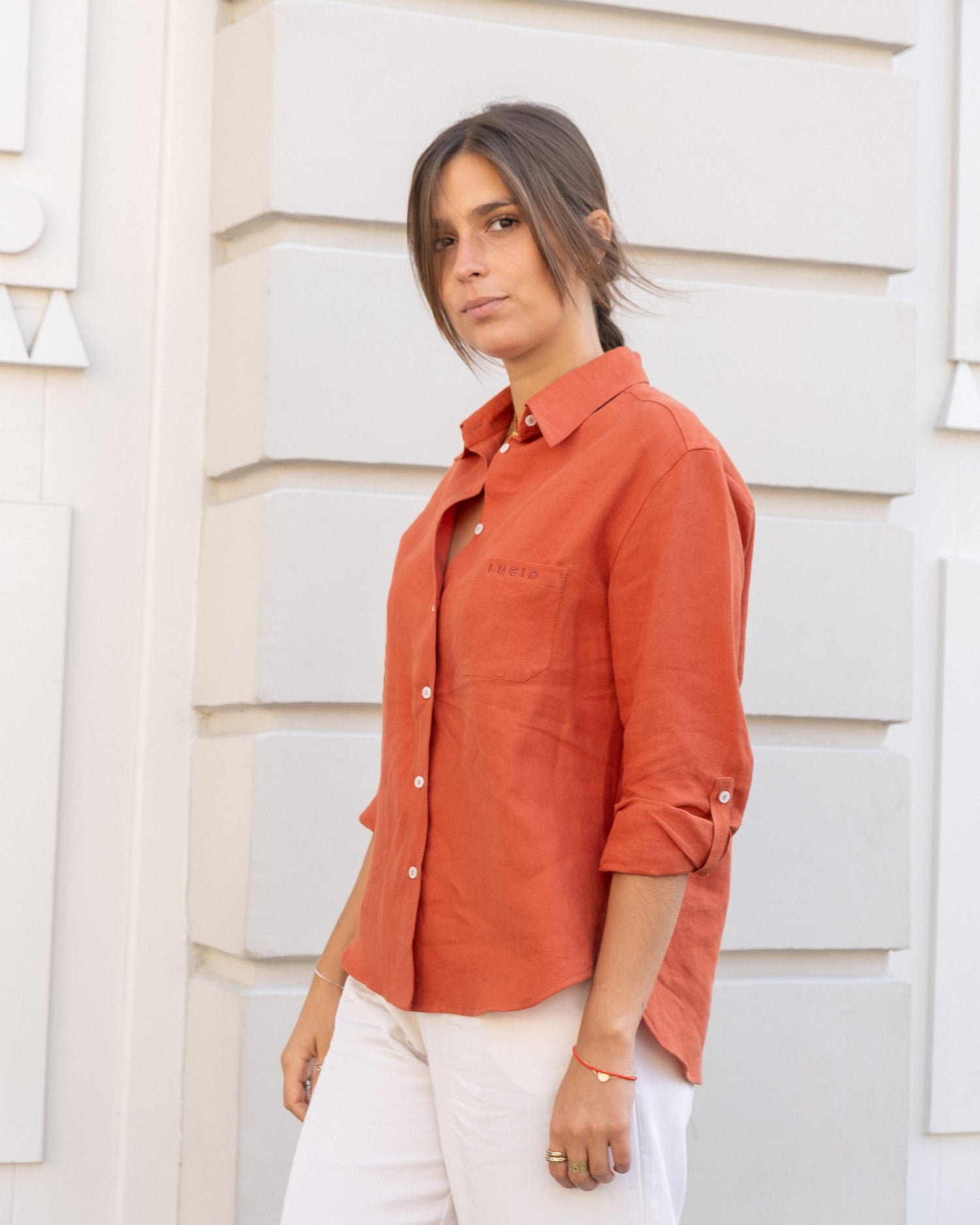

Noticed something? As soon as the sun peeks out, linen takes over the racks. Breathable, durable, and naturally elegant, it ticks all the boxes for responsible fashion. Looking for that rare gem to complete your wardrobe? Look no further: we've selected the 10 best linen clothing brands for you.
And because making a responsible choice starts with understanding what you wear, we'll also explain why this local plant is the best thing that can happen to your wardrobe, and to the planet.
Our selection of the 10 best linen clothing brands
Lucid Collective
Lucid offers uncompromising linen pieces for men and women. The linen used is organic European linen, grown in France, woven in Belgium, and Masters of Linen certified, guaranteeing complete traceability from fiber to finished garment. The fabric is distinguished by a generous thickness of approximately 225 g/m², dense enough to offer a beautiful drape, a style for all seasons, and to avoid any transparency, while remaining breathable and comfortable.
Each creation is made in Brussels in a social reintegration workshop, giving a human and solidarity dimension to each piece. Designed to last for years, Lucid linen shirts are guaranteed for life, a rare commitment that reflects both the quality of the product and the desire to combat textile obsolescence.
BonneGueule
BonneGueule offers linen clothing designed for those who want well-cut, easy-to-wear pieces created with a real focus on materials. The brand emphasizes textile education, fabric quality, and durable cuts that transcend seasons.
In its linen range, you'll find elegant and versatile pieces, suitable for both summer outfits and more dressed-up looks. A good option for those who want quality linen with a neat and contemporary style.
Colorful Standard
Founded in Copenhagen, Colorful Standard has built a solid reputation around its brightly colored organic cotton basics. The brand applies the same philosophy to its linen range, with long-sleeve shirts, short-sleeve shirts, oversized cuts, and shorts, available for men and women in a palette of over 35 colors.
All pieces are made in Portugal, with a simple, colorful, and sustainable approach. Colorful Standard is a good option if you're looking for everyday linen clothing with a brighter touch than classic natural tones.
Armedangels
Based in Cologne, Armedangels is a benchmark in ethical fashion. Every piece is designed with a logic of social and environmental responsibility, with recognized certifications such as GOTS, Fair Wear Foundation, and Fairtrade.
For linen, the brand sources exclusively from crops without pesticides, chemical fertilizers, or GMOs. For both women and men, the linen range includes blouses, tops, pants, shorts, and dresses: a complete, understated, and committed summer wardrobe.
SKFK
SKFK breaks the codes of linen, often considered too classic. Born in the Basque Country, the brand committed to sustainable fashion from its beginnings, certified GOTS and Fairtrade, with a recognizable style of bold colors.
Its linen is Masters of Linen certified and integrated each season into pieces with graphic patterns and asymmetrical cuts, proving that sustainable fashion can also rhyme with creativity. If you're looking for a linen garment that stands out from the ordinary, this is a brand to follow.
Dedicated
Founded in Stockholm by a group of design-loving friends, Dedicated was born from a simple observation: too few brands seemed genuinely concerned about the environment. Today, it is recognized for its graphic pieces and cutting-edge artistic collaborations.
The brand offers linen shirts and blazers with colors and embroideries that make it unique. For those who want ethical linen with a true visual identity, Dedicated is a distinctive choice.
Givn
Inspired by the Berlin lifestyle, Givn offers a minimalist and casual style. GOTS certified and PETA Approved Vegan, the brand manufactures all its collections in Europe, in workshops with fair working conditions.
The linen it uses, free of pesticides, offers durable and moisture-regulating clothing. Linen pieces are available for women and men, with a sober and timeless aesthetic that is the brand's strength.
Asphalte
At Asphalte, they don't do things by halves. Their linen is Masters of Flax Fibre™ certified, guaranteeing European origin. But their real strength is the weight of the material: with a grammage of 234 g/m², their linen is denser than the market average.
The result: a garment that holds its shape, doesn't wrinkle with every movement, and offers good opacity. Asphalte is an interesting option for those who want robust, structured linen designed to last.
About Companions
This Berlin brand creates men's basics designed to become your best "companions" for life. Their linen clothes, ethically made in Lithuania and Portugal, are pre-washed to offer immediate comfort.
We particularly appreciate their sustainable approach: their products are designed to last, and the brand offers a free repair guarantee for every purchase. From blazers to linen socks, everything is made to stay in your wardrobe for a long time.
If you're too lazy to read it all
🌡️ Thermoregulation: linen keeps you cool in summer and warm in winter thanks to its airy structure.
🌍 Ecology: it's a sober plant that requires very little irrigation and few chemicals.
🇫🇷 Origin: France is the world's leading producer, with much of the quality linen grown between Normandy and Amsterdam.
🔎 Quality: good linen is recognizable by its tight weave, supple feel, and high grammage to ensure opacity.
💎 Price: it's more expensive than cotton because it represents less than 1% of global fibers and requires more complex production.
✅ Labels: rely on European Flax™ for origin and Masters of Linen™ for 100% European manufacturing.
Why is linen the ideal fiber?
Linen is somewhat the superhero of textiles. Its first superpower? Thermoregulation. Thanks to its naturally airy structure, it keeps you cool in summer and retains body heat in winter. Unlike synthetic materials, it can absorb up to 20% of its weight in moisture without feeling wet to the touch.
It's also a hypoallergenic and antibacterial fiber, ideal for sensitive skin. But the real clincher is its ecological footprint. Linen is a sober plant: it requires almost no irrigation, rainwater is sufficient, and very few chemicals. Choosing linen means opting for a garment that doesn't wear out but softens and improves with time.
Where is the world's best linen produced?
No need to go to the other side of the world: the treasure is at our feet. France is the world's leading producer of fiber linen. With its Belgian and Dutch neighbors, it forms a privileged growing area stretching from Caen, Normandy, to Amsterdam.
Why here? Because linen needs a specific oceanic climate: humidity, strong winds, and rich soil. This coastal strip produces approximately 80% of the world's high-quality linen. Buying European linen means supporting unique local expertise and guaranteeing almost unbeatable traceability.

How to recognize a quality linen garment?
To avoid mistakes, trust your senses. Quality linen is first recognized by its weave. Hold the garment up to the light: the mesh should be regular and tight. If you see large knots, called "slubs," too repeatedly, it often indicates a short fiber, which is less durable.
The feel is also an excellent indicator. Good linen should not be stiff or scratchy. It should have a certain suppleness, even when new. Finally, check the fabric's weight, also known as grammage: the higher this number, the more robust the garment will be, the better it will drape, and it won't be transparent.
Why is linen more expensive than cotton?
Its production is much rarer and more complex. Linen accounts for less than 1% of global textile fibers. Unlike cotton, it requires more technical, longer steps and is highly dependent on the weather.
This precision work guarantees a strength not always found in industrial materials. The price of linen therefore reflects its rarity, the quality of its fiber, the technicality of its transformation, and the expertise required to produce a durable textile.

What are the reliable certification labels for linen?
To navigate the jungle of labels, you can consult our complete article on labels and certifications in sustainable fashion. For linen, remember these two labels in particular:
European Flax™: This is the origin visa. It guarantees that the linen fiber is grown in Western Europe, without irrigation, without GMOs, and with responsible crop rotation.
Masters of Linen™: This is the higher level. This label guarantees that all stages, from cultivation to spinning and weaving, have been carried out in Europe. It is a guarantee of reduced carbon footprint, clear traceability, and technical excellence.
In summary: the choice of lasting fashion
Linen is not just a fabric; it's a commitment to more local and respectful fashion. By favoring this fiber, you support virtuous agriculture, unique expertise, and a European textile industry recognized worldwide.
Want to find the perfect piece for this summer? If you're specifically looking for a shirt, we also have a comprehensive guide on the best linen shirts.
Sources
- FranceAgriMer. (2026, February). Fiche filière: Le lin fibre en 2026. https://www.franceagrimer.fr/sites/default/files/2026-02/22_FICHE_FILIERE_LIN_2026.pdf
- Givn Berlin. (n.d.). Eco-fashion and Linen. https://www.givnberlin.com/
- Knowledge Cotton Apparel. (n.d.). Our Heritage and Fabrics. https://knowledgecottonapparel.com/
- Lucid Collective. (n.d.). Notre journal et nos engagements. https://lucid-collective.eu/
- Marques de France. (2023). Définition et caractéristiques du lin. https://www.marques-de-france.fr/definition/lin/
- SKFK. (n.d.). Ethical Fashion and Design. https://www.skfk-ethical-fashion.com/