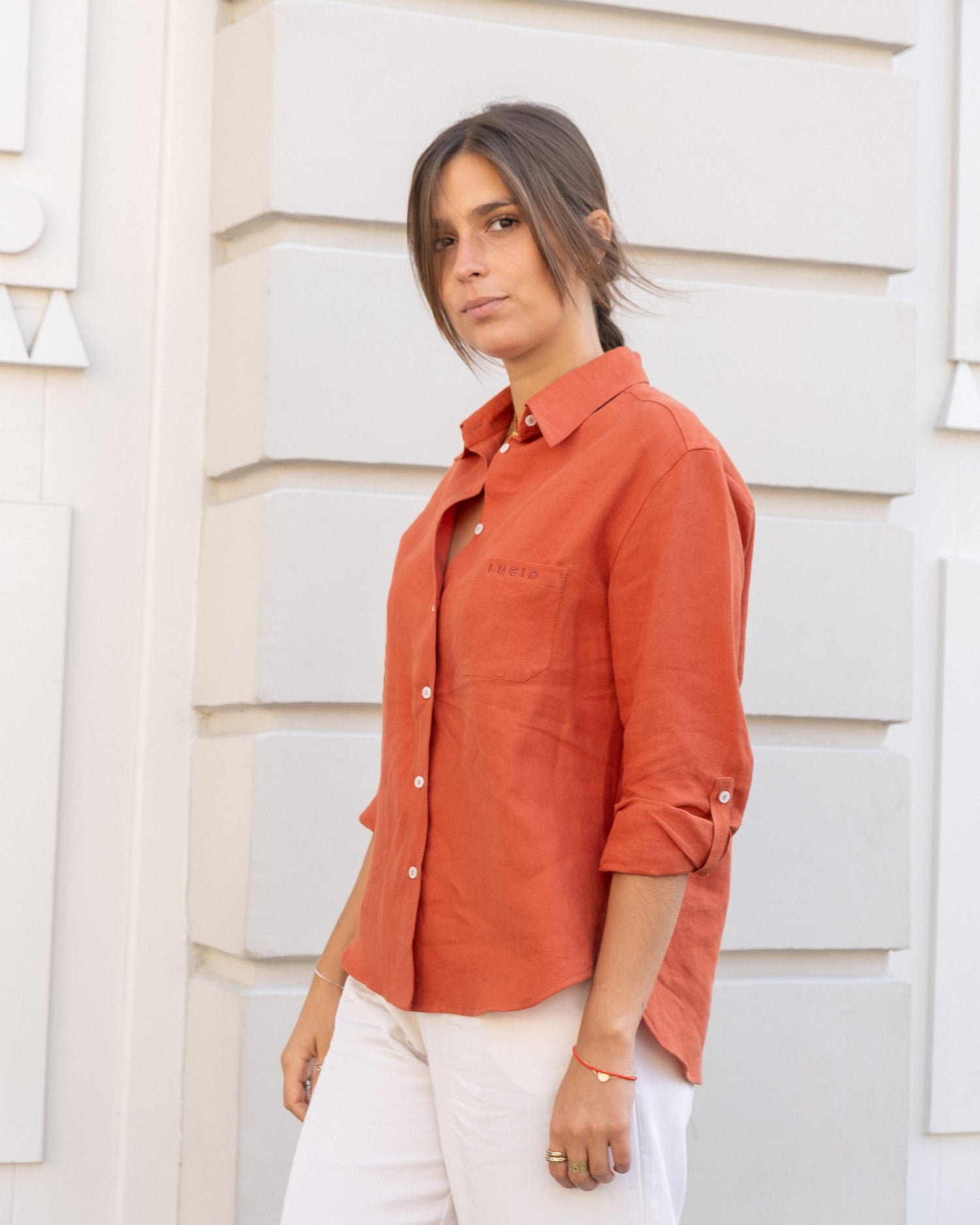

From the very beginning of Lucid, we set ourselves the ambitious, and frankly somewhat naive, goal of creating a 100% Belgian garment, from plant to finished product. We quickly realized that the real problem lay in the choice of textile.
Ah yes, Belgian cotton is not for the immediate future (but given the acceleration of climate change, what a joy it would be to see it growing along the E411, wouldn't it?).
Two materials do offer us this possibility: hemp and flax . While we are still testing to develop the first (this sly fellow is still having some trouble with the law), we have thoroughly studied the second because it is simply incredible: durable, local, strong, breathable, biodegradable, etc.
In short, we're sharing everything we learned about linen during the two years it took to develop our shirt 👇
If you're too lazy to read everything:
🌱Linen is a natural fiber that has been used for millennia for its textile qualities.
🔨Flax cultivation takes place largely in our countries but its processing is mainly done in Asia, hindering its local character.
🌿Resistant, thermoregulating, absorbent, and hypoallergenic, linen is a durable and comfortable fiber to wear, in summer as in winter.
🌍Its cultivation respects the environment and enriches the soil, with little ecological impact. Flax is also zero waste; everything is used.
💸Linen represents less than 1% of the fibers used because we have lost know-how and production is long, which makes it more expensive.
⏳It softens and becomes more beautiful over time, gaining in smoothness and natural patina.
✅ The Masters of Linen label ensures that the certified linen has not left Europe, from cultivation to processing.
What is flax?
Linen is a natural fiber derived from the Linum usitatissimum plant (that's what we call it in the Lucid offices too, don't worry). Used for millennia, it is known for its strength and breathable properties .
Very popular today for its ecological qualities, it is mainly grown in our regions (France, Belgium, Netherlands), ideal thanks to their humid and temperate climate.
And in order to better understand what linen really is and especially to have access to quality/local linen, we have partnered with THE Belgian star in the field: Libeco (and its boss Raymond Libeert).

How is linen fabric made?
According to R (Raymond is our go-to guy now), linen fabric is made in the following way:
After harvesting, the flax stalks are left on the ground to undergo a natural process called retting , where microorganisms break down the plant's outer layer to release the fibers. These fibers are then sorted and spun into yarn, then into textiles, and finally dyed.
Historically speaking, everything was done in Belgium/France . Today, the situation is rather alarming: 75-85% of the world's linen production takes place between Caen and Amsterdam (via Belgium) but more than 80% of this production is exported to Asia to be transformed into clothing which will then be re-shipped to Europe.
We're living in a topsy-turvy world.
Raymond also told us that it's primarily the disappearance of local flax mills (which process the plant into yarn) in favor of Asian mills, and the resulting loss of expertise, that is slowing down a complete relocation. This trend is slowly reversing, with spinning currently possible in Poland, Lithuania, and Italy.
You know us, we obviously made sure that our linen only passed through these subsidiaries. To ensure this, our linen is Masters of Linen certified , guaranteeing that it has never left Europe.

What are the qualities of flax?
Linen is packed with qualities:
- Resistant : Its fiber is 30% stronger than cotton.
- Hypoallergenic : It is gentle on sensitive skin.
- Thermoregulating : Cool and breathable in summer, keeps you warm in winter.
- Absorbent : absorbs up to 35% of its weight in water and diffuses the moisture (goodbye sweat stains)
- Biodegradable : Completely natural, it degrades perfectly at the end of its life.
- Zero waste : The entire plant is used during its processing
As you correctly understood, we had no choice but to choose it for our shirt.
Is linen eco-friendly?
To be honest, at first we focused on hemp, given the incredible environmental qualities attributed to it in the industry. But that was without taking into account what we discovered about flax.
Its cultivation requires VERY little water (115 liters per kg of finished flax compared to 10,000 liters for cotton!) because flax only needs rainwater during its growth. Natural rainfall in our regions is sufficient.
It is a robust plant that requires few chemical inputs (fertilizers, pesticides). Furthermore, it nourishes and enriches the soil , which is why flax is often used as a rotation crop.
The mechanical processing of flax consumes little energy , and if it can be processed locally, the impact of transportation is reduced . All of this makes it a serious contender for the title of the most environmentally friendly fiber.

Why is linen expensive?
Because Raymond and Lucid obviously want to line their pockets.
More seriously, linen costs more due to several factors :
- The transformation is lengthy and the know-how is somewhat forgotten , which makes production more complex.
- Labor in Europe , where flax is predominantly grown, is more expensive than that of "globalized" cotton.
- For flax going through an Asian spinning mill, there are high transport costs .
- Global flax production is much lower than that of other natural fibers such as cotton, therefore there are fewer economies of scale.
By giving increasing priority to materials like local flax (not even 1% of current global fiber production), we will boost demand, which will gradually make it cheaper .
And that's why we're taking action now at Lucid to offer you shirts made from local linen.
Why wear linen?
Now that's a question. Because it's really great.
Wearing linen means choosing comfort and durability . In summer, it keeps you cool thanks to its thermoregulatory properties, while remaining warm enough to be worn in the mid-season.
Hypoallergenic and antibacterial , it is ideal for those with sensitive skin or who want a breathable garment.
Moreover, it softens over time , guaranteeing you lasting comfort.
Finally, from a more personal point of view, we find that it gives an authentic look to the garment and is easy to coordinate with the rest of one's wardrobe.
How does linen age?
Just like George Clooney, linen gets better with age .
Each wash makes it softer and more comfortable to wear , and its fibers develop a natural patina under the effects of sunlight and washing . This is what makes each linen garment unique and even more beautiful over the years.
At Lucid, we've even decided to offer a lifetime guarantee on our linen shirts . So you can decide who ages better: you or your shirt.

What are the advantages and disadvantages of flax?
Okay, we'll summarize everything here so you can talk about it at the family meal next week:
| Benefits | Disadvantages |
| Eco-friendly : no water irrigation, few pesticides and fertilizers, good for the soil, … | Wrinkles easily : Although this depends on the manufacturing processes used |
| Zero waste : All parts of the plant are used (textile fibers, fodder, compost). |
Spinning in Asia : The majority of flax is spun in Asia, which increases its carbon footprint and reduces its local character. |
| Local production : Primarily grown in Europe, creating jobs, … | High costs : Production requires specific expertise, which makes it more expensive. |
| Built to last : Stronger than average and ages well. | |
| Comfortable : hypoallergenic, fluid, absorbent, … |
To address this, at Lucid we decided to choose a thick linen which is less prone to wrinkling, spun in Europe and woven in Belgium to keep it local and at a cost which remains affordable for as many people as possible.
Conclusion
In our quest for 100% Belgian clothing, linen stood out as a sensible solution and easier to relocate.
That is why it is a pleasure to be able to offer our community a linen shirt for men and women , designed with respect for the environment and with local know-how.
For the making of our shirts, linen brilliantly replaces cotton, beating it on issues of environmental impact, durability, comfort and above all relocation .
While a large majority of flax is grown in our countries, an equally large majority is processed in Asia, which raises questions about the impact of transport, traceability and respect for workers' social rights.
By circumventing this phenomenon by surrounding ourselves with the best possible local partners, we have managed to make a fantastic linen shirt which, in our humble opinion, has the potential to change the textile industry.
Sources:
- Alliance Flax-Linen-Hemp. (2024). Environmental Responsibility of European Flax. Alliance Flax-Linen-Hemp. https://allianceflaxlinenhemp.eu/fr/responsabilite-environnementale-lin-europeen
- Iznowgood. (2021). All about linen, the most eco-friendly material. YouTube. https://www.youtube.com/watch?v=_yXH2yWjoUY&t=29s&ab_channel=Iznowgood
- The Good Goods. (2024). Linen. The Good Goods. https://www.thegoodgoods.fr/matieres/lin/
- Vert. (March 24, 2022). Organic linen: the local and eco-friendly alternative to cotton is rebuilding a French supply chain. Vert.eco. https://vert.eco/articles/le-lin-bio-alternative-locale-et-ecolo-au-coton-se-retisse-une-filiere-francaise
- WeDressFair. (2024). Linen: an eco-responsible material? WeDressFair. https://www.wedressfair.fr/matieres/lin
- Impossible. (2024). Impossible. Impossible. https://www.linpossible.fr/
- ADEME. (2012). Comparative life cycle analysis of textile fibers. French Agency for Ecological Transition. https://librairie.ademe.fr/changement-climatique/1395-analyse-du-cycle-de-vie-comparee-de-fibres-textiles.html
- Masters of Linen. (2024). Linen, a sustainable and European fiber. Masters of Linen. https://www.mastersoflinen.com