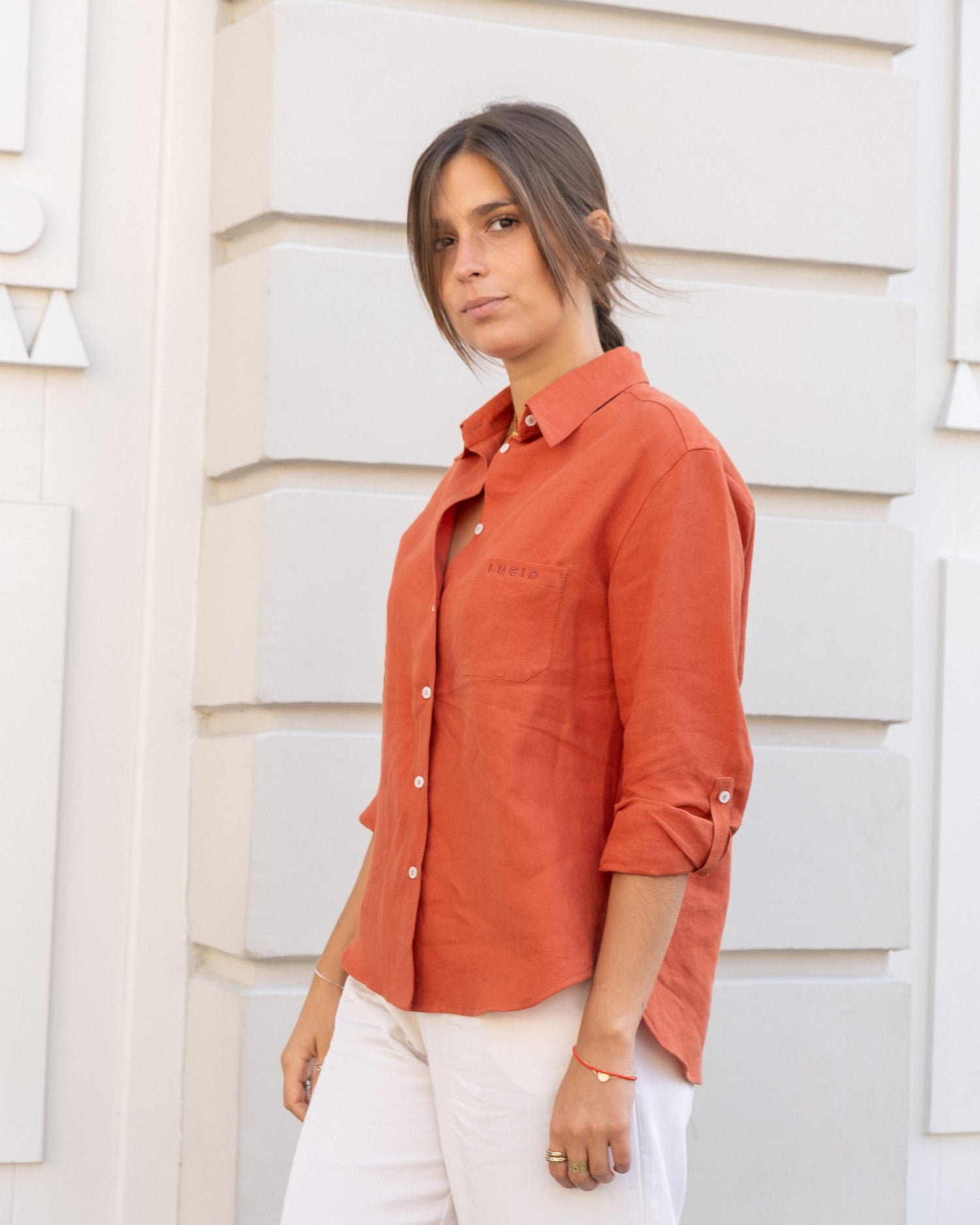

Textile hemp is making a major comeback . Having disappeared from the scene for decades , overshadowed by cotton and synthetic fibers , it is now regaining the spotlight it deserves. Ecological , durable , and utterly timeless , this age-old material ticks all the boxes for more responsible fashion.
At Lucid, we no longer see it as just a fiber, but as a symbol of an alternative to polluting textiles and a real lever for a meaningful circular economy . And honestly, when we looked into it, we wondered why we weren't already seeing it everywhere.
So, we'll tell you everything: how hemp is transformed into textiles, why its environmental impact is much lighter than that of cotton, and how its historical heritage can inspire the fashion of today and tomorrow 👇
What is hemp fabric?
Hemp fabric is obtained from the stems of the Cannabis sativa L. plant. Unlike cotton, it requires neither intensive irrigation, nor pesticides, nor chemical fertilizers to grow. The extracted fiber is then spun into yarn, and finally into textiles, renowned for their strength, comfort, and natural antibacterial properties .
Today, hemp is seen as one of the most promising materials for sustainable and ethical fashion .

Rest assured, this one has nothing to do with the recreational version: it contains less than 0.2% THC.
The process of transforming textile hemp
Hemp isn't "plug and play": it takes a bit of a process to transform the stalk into fabric. But the good news is, it's a pretty eco-friendly process.
The transformation of hemp into textiles relies on several key steps:
- Harvesting : The stems are cut before flowering, to preserve the length of the fibers.
- Retting : This biological process allows the fibers to separate from the stem through moisture, in open air or in a controlled manner.
- Scutching and combing : The fibers are then separated from the woody part (shives) and combed to obtain long and homogeneous fibers.
- Spinning : Long and short fibers are transformed into yarn. Recent mechanization facilitates this process, which was once complex.
- Weaving and knitting : Yarn is used to create a wide variety of fabrics, from sturdy denim to lightweight canvases.

Source: Couleur Chanvre
The ecological benefits of hemp
Cotton has long reigned supreme, but it has one major drawback: it absorbs far too much water. And that's not even mentioning the mountain of pesticides used to grow it. If you'd like to learn more, we've written an article on organic cotton .
Hemp, on the other hand, does much better:
- Low water consumption : up to 10 times less than cotton.
- Little or no pesticides : hemp is naturally resistant to diseases and weeds.
- Soil improvement : its deep roots promote soil aeration and biodiversity.
- Carbon storage potential : hemp captures large quantities of CO₂ during its growth.
- Circular economy : every part of the plant can be used (textile fibers, insulation, bioplastics, food).
These qualities make it a key raw material for a sustainable and ethical textile industry .
Hemp throughout history
It has accompanied humanity for millennia:
- Antiquity : used in Asia for ropes and clothing.
- Middle Ages : in Europe, it was the king of fibers for sails, ropes and canvas.
- 19th century : challenged by cotton, which was easier to industrialize.
- 20th century : marginalized because of its association with recreational cannabis.
Today, faced with climate and social challenges, the revival of textile hemp reflects an urgent need to return to sustainable and local materials .
What kinds of clothes can be made from hemp?
Thanks to technological advances, hemp textiles are no longer rough or stiff:
- Durable jeans and trousers .
- Soft and breathable shirts and t-shirts .
- Sturdy jackets and coats .
- Lingerie and sportswear , thanks to its thermoregulatory properties.
- Accessories : bags, hats, shoes.
In addition, blends with organic cotton or linen allow for the creation of soft fabrics, suitable for current trends.

Properties and care of hemp textiles
Hemp clothing truly possesses unique qualities that make it particularly suitable for everyday wear. Naturally antibacterial and antifungal , it helps maintain a feeling of freshness and hygiene, even after several hours of wear. Its thermoregulating fibers keep you cool in summer and warm in winter, making it a comfortable choice all year round.
In addition to being breathable and absorbent, hemp textiles are exceptionally strong , with a durability far superior to that of cotton, and they have the particularity of softening over time , while retaining their robustness.
Care is incredibly simple: wash at a low temperature (30°C) and air dry. Clothes that last and become even more comfortable to wear over the years.
Hemp vs. Flax: What are the differences and similarities?
At Lucid , we love exploring all the natural materials that allow us to create more responsible fashion . Hemp and linen are often compared , and not without reason: they are both ancient , durable , and eco-friendly European fibers. But while they share many qualities, each has its own unique character.
Linen is renowned for its fineness and natural softness . It is grown primarily in northern France and Belgium and benefits from a highly structured and industrialized industry. The fiber is pleasant to the touch , light , and fluid , making it an ideal material for summer clothing or delicate garments . Linen also has the advantage of aging gracefully : the more it is worn, the more comfortable and pleasant it becomes against the skin.
Hemp , on the other hand, is the stronger of the two. Its cultivation is less demanding : it can grow in poorer soils and needs even less water and inputs than flax , which already requires very little. Initially, its texture is more rustic than flax's, but it softens with each wash and retains exceptional strength . Its deep roots and rapid growth allow it to capture more CO₂ , further enhancing its positive environmental impact.
Linen and hemp complement each other more than they clash. Together, they offer a credible and far more sustainable alternative to conventional textiles. If you want to learn more about linen, we've written an article about it .
Conclusion: Hemp textiles, a pillar of sustainable fashion
Textile hemp is not just a rediscovered ancient material: it represents a solution for the future of more ethical and planet-friendly fashion. Resistant, ecological, and versatile, it fits perfectly into a circular economy vision .
At Lucid , we believe in this potential and aim to integrate hemp into our sustainable materials in the near future.
👉 If you want to see our linen clothing for women and men , feel free to click on the links.
Sources
- Hemp Color. (sd). The real thing, made in France. Hemp Color. Retrieved from https://www.couleur-chanvre.com/le-vrai-made-in-france/pgw-54
- Organic Flax & Hemp. (n.d.). Organic hemp . Retrieved from https://linetchanvrebio.org/index.php/le-chanvre-bio
- Nuntisunya. (n.d.). Textile hemp . Retrieved from https://www.nuntisunya.com/chanvre-textile
- Sillon Belge. (February 24, 2024). Textile hemp, the little brother of linen... or almost . Retrieved from https://www.sillonbelge.be/12388/article/2024-02-24/le-chanvre-textile-le-petit-frere-du-lin-ou-presque
- Valbiom. (n.d.). Long-fiber hemp: a material of the future for the textile industry . Retrieved from https://www.valbiom.be/actualites/le-chanvre-fibres-longues-un-materiau-avenir-pour-industrie-textile